
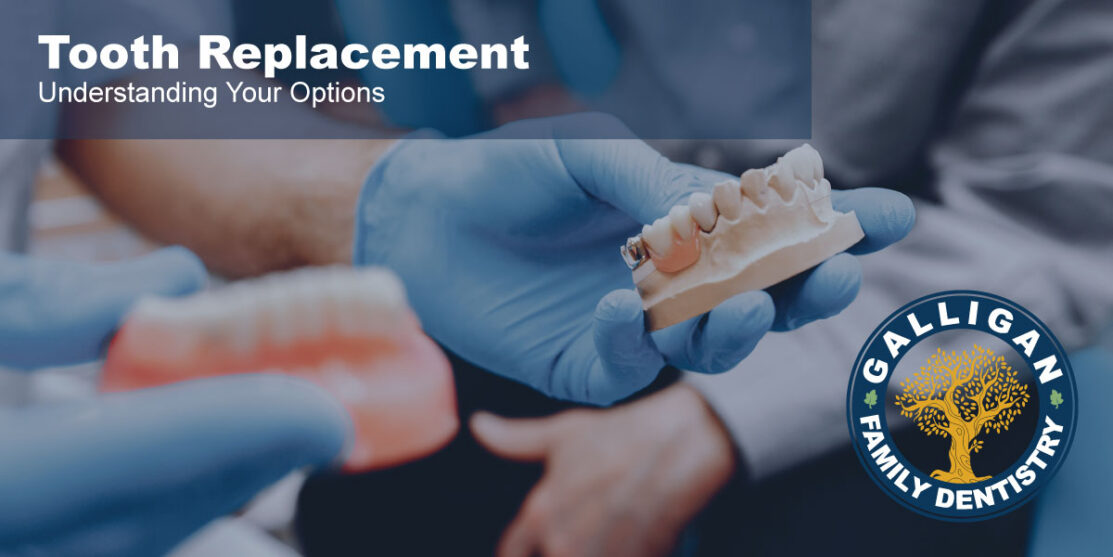
Tooth Replacement
Understanding Your Options for Restoring Function and ConfidenceLosing a tooth can feel overwhelming. Whether the loss occurs from decay, fracture, gum disease, or injury, missing teeth affect more than appearance. They can change how you chew, how you speak, and how your remaining teeth function over time.
Tooth replacement is the process of restoring a missing tooth or teeth in a way that supports comfort, stability, and long-term oral health. Modern dentistry offers several reliable options, and the right choice depends on your individual needs.
Why Tooth Replacement Matters
When a tooth is lost, several things begin to happen:
- Neighboring teeth can shift into the empty space
- Opposing teeth may drift or over-erupt
- Bite alignment can change
- Chewing efficiency decreases
- Bone support in the area can gradually diminish
Replacing a missing tooth helps maintain balance in your bite and protects the long-term health of surrounding teeth.
Tooth replacement is typically recommended when the absence of a tooth affects function, stability, or overall oral health. In some cases, it may also be considered for cosmetic reasons, especially when a front tooth is involved.
When Is Tooth Replacement Needed?
Tooth replacement may be necessary when:
- A tooth cannot be saved due to extensive decay
- A tooth fractures beyond repair
- Advanced gum disease causes tooth loss
- Trauma results in a knocked-out tooth
- Multiple teeth are missing in one area
In these situations, restoring the space helps preserve proper bite function and prevent additional complications.
Tooth Replacement Options
There is no one-size-fits-all solution. The best option depends on the number of missing teeth, the health of surrounding teeth and bone, and your long-term goals.
1. Dental Bridges
A dental bridge replaces one or more missing teeth by anchoring to the natural teeth on either side of the gap. The adjacent teeth are prepared to support a fixed prosthetic tooth that fills the space.
Bridges:
- Restore chewing ability
- Maintain alignment
- Provide a non-removable solution
- Are supported by natural teeth
Bridges are often recommended when neighboring teeth already need crowns or when implant placement is not ideal.
2. Implant Restorations
Dental implants are placed surgically by a specialist and act as artificial tooth roots. Once healing is complete, a crown is attached to the implant to complete the restoration.
Implant restorations:
- Function independently of surrounding teeth
- Help preserve bone structure
- Provide strong, stable support
- Feel and function similarly to natural teeth
Over time, the crown portion of an implant may need replacement due to normal wear, even though the implant itself remains stable.
3. Partial Dentures
Partial dentures are removable appliances used when multiple teeth are missing but some natural teeth remain.
Partial dentures:
- Replace several teeth in one arch
- Help restore chewing function
- Provide a cost-effective solution
- Can be adjusted as needs change
They are designed to improve function and appearance while remaining removable for cleaning.
4. Full Dentures
When all teeth in the upper or lower arch are missing, full dentures provide complete replacement.
Modern dentures:
- Restore facial structure and support
- Improve speech and chewing
- Are custom-designed for fit and comfort
Periodic adjustments may be necessary as the mouth changes over time.
Choosing the Right Option
Selecting a tooth replacement solution involves evaluating:
- Bone support
- Condition of surrounding teeth
- Overall oral health
- Long-term durability
- Budget and insurance considerations
- Personal preference
During your consultation, we review these factors carefully and explain the benefits and limitations of each option. The goal is not simply to fill a space, but to restore balance, comfort, and long-term stability.
Preventing Future Tooth Loss
Tooth replacement is important when necessary, but prevention remains the priority. Regular cleanings, early treatment of decay, and managing gum health all play critical roles in protecting natural teeth for as long as possible.
Modern dentistry allows many people to keep their natural teeth for a lifetime. When replacement becomes necessary, thoughtful planning ensures the result supports both function and confidence.
If you are missing a tooth or have been told one may not be restorable, a consultation can help clarify your options and create a plan that supports your long-term oral health.